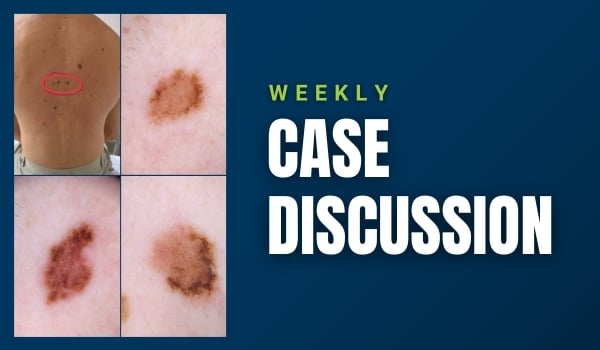



This week's case discussion was submitted by Angie, a Melanographer. A 37-year-old male patient with
Build a strong foundation in aesthetic medicine tailored to nursing practice, with a focus on safety, patient assessment, and real-world clinical application.

Aesthetic medicine is a rapidly growing area of practice, with increasing patient demand for safe, evidence-based treatments delivered by qualified clinicians. With the right training, nurses can play a key role in providing high-quality aesthetic care in clinical settings. This course is designed to give you the foundational knowledge and clinical framework required to safely assess, plan, and support aesthetic treatments.
- Focus on practical application, patient safety, and professional decision-making.
- Build confidence in everyday clinical scenarios.
- Ideal foundation course for nurse practitioners and degree-qualified, AHPRA-registered nurses with little knowledge in aesthetic medicine.
- Registered Nurses have provided documentation on Scope of Practice for nurses to facilitate their CPD in this field.
100% online
$1595
133 hrs
- Build a solid foundation in aesthetic medicine tailored to nursing practice
- Strengthen patient assessment and clinical decision-making skills
- Develop a clear understanding of facial anatomy and skin ageing
- Learn how to support safe, effective treatment planning
- Recognise and manage common aesthetic presentations and complications
- Apply evidence-based principles in everyday clinical scenarios
- Gain confidence working within safe, compliant clinical frameworks
- Prepare to play an active role in delivering high-quality aesthetic care
Get unlimited access to all course content, additional learning materials, ongoing post-course support, and more.
In this module, the concept of aesthetic medicine and the correct approach for patients seeking aesthetic treatments is described. Topics include the history of aesthetic medicine, applying various aesthetic medicine treatment options in a primary care setting, typical aesthetic presentations and how to assess the aging face. An aesthetic consultation and treatment plan is included.
In this module, the process of skin ageing is examined commencing with the function of the skin and what happens to skin structure as the skin ages, including skin of colour. Intrinsic and extrinsic factors that cause the skin to age are discussed. Assessment tools including the Fitzpatrick skin types, Glogau classification, Johnson’s wrinkle scale, Weiss’s, Merz scales and Lever are outlined. Quizzes are presented to encourage participants to familiarise with the most common assessment tools. Grading acne severity scales and Roberts hyper-pigmentation and scarring severity scales are discussed in detail. Skin analysers are introduced as a potential skin assessment tool. The content then moves to treatment planning information including prevention, medical, aesthetic and cosmeceutical options.
Understanding facial anatomy is critical for successful aesthetic treatment outcomes. Patient considerations include gender, race, age, medical history (including previous facial treatments), face shape and other considerations. There is a detailed focus on the facial sub-units, innervation, vascularization, lymphatics and musculature systems of the face and neck. These areas are crucial when evaluating a patient for safe aesthetic treatments and determining the appropriate treatment modality. The signs and symptoms of potential adverse outcomes are included.
This module focuses on identifying specific skin conditions suitable for facial peels and how to evaluate the use of skin conditioning and retinoids in aesthetic medicine. Tools to assess skin conditions are introduced including the classification of photo damage. The wound healing process and understanding of skin anatomy are featured before moving into understanding what a chemical peel is, and expected reactions and complications from chemical peels. The module concludes with a detailed description of how to perform a chemical peel.
This module describes wrinkle-relaxant treatment, its cosmetic and non-cosmetic uses and available wrinkle-relaxant treatment brands. The molecular structures and modes of operation are detailed. Patient consent and assessment including gender, muscular differences, skin quality, symmetry, history, contraindications and precautions are important considerations for considering the use of wrinkle-relaxant treatment. Determining the best target site, deciding the administration technique and marking out entry points are outlined. Potential issues and complications are explained.
This module outlines why volumisers are considered a useful aesthetic medicine option and describes appropriate application areas for volumisers. Three types of fillers are addressed – temporary fillers, permanent fillers and biostimulators. Patient assessment includes history, skin ageing and texture and a detailed examination of the patient before developing a treatment plan including product selection. The module also covers contraindications, side effects and how to manage side effects, and complications including granulomas, vascular compromise, infection and biofilm.
This module outlines the treatment process for volumisers including patient assessment, written patient consent and the importance of photos pre and post treatment. Anaesthesia options, needle choice and a variety of administration techniques are discussed. After treatment care is included for patient information.
This module details injectable procedures including deoxycholic acid, wrinkle-relaxant treatment, volumisers and biostimulators. The importance of knowing your muscular and vascular anatomy is stressed to minimise adverse reactions. Severe reactions including syncope, seizures and anaphylaxis are detailed. Local anaesthetic complications, ptosis, skin irritations, bruising, dysphagia, dysphonia, pain, granulomas, necrosis, asymmetry, discolouration, oedema, angioedema, lumps/nodules, infection, biofilm and vascular occlusion are some complexities covered. Prevention strategies to minimize adverse outcomes are outlined and symptoms of complications and manageing these complications are included.
This module introduces nurses to the legal, ethical, and professional standards required for safe aesthetic practice. It covers AHPRA advertising rules, TGA restrictions on Schedule 4 medicines, and state-based Poisons Act requirements for medication governance, storage, prescribing, and documentation. Participants learn how to maintain compliance, manage consent, ensure cultural safety, identify psychological red flags such as BDD, and uphold professional integrity in all patient interactions. The module also explores scope of practice for ENs, RNs, and NPs, including supervision, delegation, and clinical governance to support safe, accountable aesthetic nursing.

Aesthetic Medicine Physician and Medical Director at Southern Cosmetics, Victoria
Fellow of the Cosmetic Physicians College of Australasia
HealthCert Course Chair for Aesthetic Medicine
Dr Jenny Kimmins spent many years in General Practice before developing an interest in management and treatment of skin conditions. She has over 10 years’ experience in cosmetic medicine, including the management of acne and rosacea, laser skin treatments, dermal fillers and anti-wrinkle injections. She is a lecturer and trainer in aesthetic medicine and injectable cosmetic treatments. Jenny completed a postgraduate Diploma in Dermatology with the Australian Institute of Dermatology and is a trained skin cancer physician with a special interest in sun-damaged skin. She was recently awarded a Fellowship of the Cosmetic Physicians College of Australasia.

Skin Cancer and Aesthetic Medicine Physician, Croxton Medical Centre, Victoria
Principal doctor at Croxton Medical Centre, Dr Chris Clifopoulos established the practice shortly after completing his training as a resident doctor in St. Vincent’s Hospital, Melbourne. He then obtained his equivalent qualification in Athens. Chris obtained his First Part qualification training for the Royal Australasian College of Dermatology in 1995. He also completed a postgraduate diploma of Epidemiology and Biostatistics in 1997 at the University of Melbourne. He completed his Master of Skin Cancer Medicine through The University of Queensland in 2011.

Doctor at National Skin Cancer Centres, New Town
Additional qualifications: MMed (Skin Cancer), Dip. Aesthetic Medicine (AAAM)
Dr Dianne King has been working as a family GP for over 20 years, a graduate from UTAS medical school in 1989.
She has had a keen interest in dermatology throughout this time and obtained her DPD in Cardiff while working in the UK during the early part of her career.
In the last 18 years, she has subspecialised in skin cancer medicine and surgery, obtaining her Masters of Medicine in Skin Cancer from UQ in 2010.
Di established one of the first standalone skin cancer clinics in Hobart with her business partners in 2009, and in recent years has undergone further training in aesthetic medicine. This has proven to be great adjunct to her skin cancer practice, evolving into a business model of the “one stop skin shop” where everything from skin cancer diagnosis and treatment, phototherapy for aesthetic and dermatological conditions, and various cosmetic treatments are available. Di has been actively involved as a guest lecturer for UTAS medical students in skin cancer for the past 10 years.
In her “spare” time, Di also lectures for HealthCert in the recently developed Aesthetic Medicine courses aimed at primary care and skin cancer physicians.

Kelly Beasy is a Brisbane-based Nurse Practitioner with 25 years of nursing experience and 15 years in aesthetics.
Kelly began her aesthetic career in 2004 on Harley Street, London, working alongside a plastic surgeon. After returning to Australia, she went on to complete a Graduate Certificate in Cosmetic Nursing (2009), a Graduate Certificate in Remote Health (2010), and a Master of Nurse Practitioner (2020).
With a strong background in emergency medicine, Kelly continues to practice in health and urgent care while also working in aesthetics. This dual role helps ensure her skills remain current and her clinical judgement well informed.
Kelly has also worked as a senior clinical trainer, mentoring doctors, nurses, and dentists in aesthetic practice. She continues her own professional development through training with organisations such as Health Cert, Rejuran, Hugel Aesthetics, and Alkira Aesthetics.
She also serves as a field expert for the Aesthetic Medical Emergency Team (AMET), contributing to clinical education and supporting practitioners in the management of aesthetic adverse events across Brisbane.


$1595
.
Bundle two courses and save 5%, or three courses and save 10% upon enrolment.
Talk to us about deferred payment options, scholarships and special rates.

Good courses with excellent speakers. I particularly enjoyed the case study scenarios which helped to integrate the knowledge gained.
A. Tucker
Excellent! This is a great course, clearly presented, with good pictures and course book. All HealthCert's courses have been hugely valuable to my practice!
R. Mundell
HealthCert courses have become the standard by which you gauge all others.
K. Abolarinwa
| RACGP Activity Number | ACRRM Activity Number | Activity Title | Education Hours | Performance Hours | Outcome Hours | ||
|---|---|---|---|---|---|---|---|
| 403783 | 38761 | Acral lesions | 403783 | 38761 | 3.5 | 6 | 0 |
| 1430878 | 38762 | Melanoma | 1430878 | 38762 | 4.5 | 6 | 0 |
| 403766 | 38734 | The Chaos and Clues method | 403766 | 38734 | 4.5 | 6 | 0 |
| 403764 | 38723 | Algorithms and the elephant approach | 403764 | 38723 | 4 | 6 | 0 |
| 403772 | 38754 | Malignant non-melanocytic lesions | 403772 | 38754 | 4 | 6.5 | 0 |
| 1430860 | 38760 | Facial lesions | 1430860 | 38760 | 4.5 | 6.5 | 0 |
| 403769 | 38745 | Benign non-melanocytic lesions | 403769 | 38745 | 3.5 | 5.5 | 0 |
| 1425218 | 38698 | Melanocytic naevi | 1425218 | 38698 | 4 | 5.5 | 0 |
| 1404643 | 39109 | Introduction to the dermatoscope | 1404643 | 39109 | 3.5 | 6 | 0 |
| 800429 | 38764 | Acral Lesions Outcome Improvement Activity | 800429 | 38764 | 0 | 0 | 8.5 |
| 1216757 | 38763 | Diagnosing Melanomas Outcome Improvement Activity | 1216757 | 38763 | 0 | 0 | 8.5 |
| Total hours | 36 | 54 | 17 | ||||
The purpose of outcome measurement activities is to improve your clinical confidence in managing an identified learning gap. Outcome measurement activities are not a requirement of our Professional Certificate of Advanced Certificate courses; they are a requirement for Australian CPD purposes.
HealthCert Education provides a variety of outcome measurements activities to suit your needs:
HealthCert Education offers courses suitable for allied health professionals and all nurses, including Enrolled Nurses, Registered Nurses, and Nurse Practitioners. Please read the course description carefully to select a course that is right for your nursing role.
The Professional Certificate of Aesthetic Medicine for Nurses is suitable for nurse practitioners and degree-qualified nurses registered with AHPRA.
There are no prerequisites for this course and no other previous formal training is required.
Participants do not have to pass an IELTS test but, as the courses are delivered in English, proficiency in listening, reading and writing English is assumed.
Participants will require access to a computer/laptop, an internet connection and a basic level of technology proficiency to access and navigate the online learning portal.
Professionally recognised qualifications and prior studies may be recognised for entry into this course if the learning outcomes match exactly. Please ask a HealthCert Education Advisor for an individual assessment of your prior qualifications and experience.
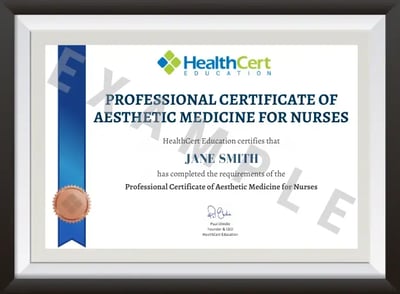
Upon successful completion of this course, you will receive the Professional Certificate of Aesthetic Medicine for Nurses in recognition of your skills.
This certificate course:
Personalised 1:1 Aesthetics Mentoring with Kelly Beasy
If you have completed Aesthetic Medicine training with HealthCert Education and want to strengthen your skills in injectables, personalised hands-on mentoring with Nurse Practitioner Kelly Beasy is the ideal next step to refine your technique, boost your confidence, and reinforce safe practice.
Receive personalised one-on-one mentoring tailored to your experience level and learning pace — beginner friendly and fully customised.
HealthCert Education is an RACGP-accredited CPD provider under the RACGP CPD Program.
Don't see your question? Explore other faqs or talk to us.
Payments can be made upfront or in monthly instalments. Special rates and various payment options are available, including discounts for course bundles. Talk to us to learn more.
Completion of any HealthCert course or attendance at an event will enable you to access the HealthCert Alumni Program which includes:
HealthCert Education is pleased to issue digital credentials for alumni. Digital credentials are a permanent online record of your successful completion of a HealthCert course and are issued to all course participants in addition to PDF certificates. If you are based in Australia, you also have the option to order a hard copy of your digital certificate for a small additional fee.
As a guideline, the recommended study duration of this certificate course is 133 hours, including online assessment and private study. This self-paced course offers the flexibility of 100% online study in your own time, at your own pace, in your own home or office, with no mandatory face-to-face requirements. You are not required to be online at specific times but can view and replay video lectures at your convenience.
All HealthCert courses meet World Federation of Medical Education standards. If you live or work outside of Australia, please contact us at admin@healthcert.com to discuss whether this course can be recognised in your country.
This week's case discussion was submitted by Angie, a Melanographer. A 37-year-old male patient with
Skin cancer excisions on the forearm and lower leg can be deceptively challenging. Planning and...
In this HealthCert GP Update, Dr Simone Gonzo guides you through the management of iron deficiency...
Want to stay up-to-date with the latest case studies, podcasts, free video tutorials and medical research articles pertinent to primary care?
Our Education Advisors can assist you with any queries and tailor our education pathway to suit your current expertise, interests and career goals.