
Prof David Wilkinson looks at a recent paper exploring the role of photodynamic light therapy (PDT) for superficial and nodular basal cell carcinoma.
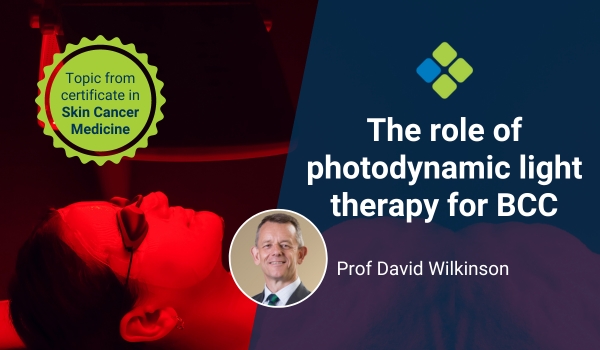
This month we look at the role of photodynamic light therapy (PDT) for superficial and nodular basal cell carcinoma (BCC).

A very interesting paper has been published in Dermatology Practical and Conceptual by Koumprentziotis et al. This paper provides a comprehensive review of the randomised controlled trials done to test PDT effectiveness in BCC.
The paper is well worth a read because it does provide a good overview of the topic, together with a collation of the randomised controlled trials.
While surgical excision is the gold standard for skin cancer treatment, and (done correctly) provides the highest cure rates, other treatments are effective in the right patient and for the right lesions.
Topical treatments can be very useful for some patients, and PDT does work (again, when done well) in some situations.
– Prof David Wilkinson
Interested in skin cancer medicine?
Read another research summary from Prof David Wilkinson: Treatment of advanced basosquamous carcinoma
Engaging with this blog can help meet your annual
|
 How to claim your CPD hours If you consume educational webinars, podcasts, articles, or research on this blog, you can Quick Log CPD hours with the RACGP via the usual self-submission process. You will be asked to reflect on what you have learned, and you will require supporting evidence such as a screenshot. Download the RACGP’s guide to self-recording your CPD here. |