

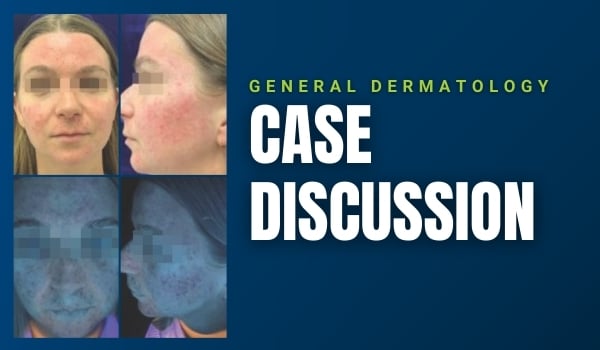
What is your management plan for this 30-year-old woman presenting with moderate-to-severe papulopustular rosacea? | General dermatology case discussion.
HealthCert Education
In this week's general dermatology case discussion, presented by Dr Dianne King, we look at a 30-year-old female patient presenting with rosacea.
Presentation
A 30-year-old woman presents with moderate-to-severe papulopustular rosacea affecting the central face. She is not taking any medications and has been using only a gentle cleanser as part of her daily skincare routine, with no moisturiser and no sunscreen.
Examination
Examination shows centrofacial erythema with multiple inflammatory papules and pustules consistent with papulopustular rosacea. Skinscope UV assessment reveals subclinical vascular changes and sun damage extending beyond what is visible under standard lighting.
-1.jpg?width=200&height=198&name=before%20(3)-1.jpg)
-1.jpg?width=198&height=198&name=before%20(1)-1.jpg)
-1.jpg?width=201&height=198&name=before%20(2)-1.jpg)
.jpg?width=200&height=176&name=before%20under%20Skinscope%20UV%20illumination%20(3).jpg)
.jpg?width=202&height=176&name=before%20under%20Skinscope%20UV%20illumination%20(1).jpg)
.jpg?width=200&height=176&name=before%20under%20Skinscope%20UV%20illumination%20(2).jpg)
What would you do next?
What management plan would you recommend for this patient? Consider both treatment of the current flare and longer-term skin barrier care.
Management plan
Here is Dr Dianne King's management plan.
- Daily broad-spectrum sunscreen commenced.
- A ceramide-containing emollient prescribed twice daily to support barrier repair.
- Ivermectin 1% cream prescribed once daily.
- Oral erythromycin 400 mg twice daily commenced, chosen over doxycycline to avoid photosensitisation.
- A gentle, non-stripping cleanser continued as the sole cleansing product.
- Dietary and lifestyle triggers (alcohol, spicy food, heat, stress) discussed and reviewed.
- Screened for depression and anxiety; no concerns identified.
- Red light LED therapy discussed. As twice-weekly clinic treatment was not feasible, a home LED mask was recommended.
Outcome
At two months (photos below), marked improvement is seen. The patient experiences a flare after stopping erythromycin and restarts treatment alongside ongoing ivermectin therapy.
.jpg?width=205&height=193&name=after%202%20months%20(2).jpg)
.png?width=201&height=193&name=after%202%20months%20(1).png)
.jpg?width=207&height=193&name=after%202%20months%20(1).jpg)
At four months (photos below), the rosacea is in remission.
.jpg?width=204&height=182&name=after%204%20months%20(2).jpg)
.png?width=201&height=182&name=after%204%20months%20(1).png)
.jpg?width=202&height=182&name=after%204%20months%20(1).jpg)
.jpg?width=206&height=180&name=after%204%20months%20under%20Skinscope%20UV%20illumination%20(3).jpg)
.jpg?width=205&height=180&name=after%204%20months%20under%20Skinscope%20UV%20illumination%20(1).jpg)
.jpg?width=204&height=180&name=after%204%20months%20under%20Skinscope%20UV%20illumination%20(2).jpg)
Clinical takeaway
The skin barrier was only partially supported before treatment began. Although the patient was using an appropriate cleanser, she was not using either a moisturiser or daily sun protection.
Restoring barrier function and reducing Uv exposure improved tolerance to treatment and enhanced the effectiveness of active therapy. Her flare after stopping erythromycin, and subsequent response to restarting treatment, illustrates why ongoing maintenance therapy — not just treatment during active flares — is central to long-term control.
Interested to learn more?
This general dermatology case is presented by Dr Dianne King and featured in A Practical Guide to Common Skin Conditions in Primary Care, developed by HealthCert Education in partnership with CeraVe.
Next steps in your learning journey
🎓 Certificate Courses in General Dermatology
Deep-dive into our university-assured, structured pathway from foundation to subspecialisation in GP dermatology.
➡️ Explore program >
🎓 Short Courses in General Dermatology
Explore short, single-topic CPD courses in focused area of dermatology. Complete in less than 10 hours, from $195.
➡️ Browse Short Courses >
🎓 HealthCert 365 subscription
Prefer flexible learning across many topics? Access 4,000+ CPD hours on-demand with HealthCert 365 — any topic, any time, one flat annual fee.
➡️ Discover HealthCert 365 >
Explore more free educational content in General Dermatology >
CPD self-submission
You can self-record CPD for this case discussion. If you consume educational content on this blog, you can Quick Log CPD hours with the RACGP/ACRRM via the usual self-submission process. You will be asked to reflect on what you have learned, and you will require supporting evidence such as a screenshot. For more information, view the: RACGP CPD guide | ACRRM CPD guide
.jpg)





.png?width=100&height=100&name=Jules%20Wynyard%20edit%20circle%20(3).png)